


"The four most dangerous words in investing are, it’s different this time." — Sir John Templeton
Greetings,
Three Down, One to Go
As we enter October, three quarters are in the books with one to go. So far, the results have been strong, particularly for stocks. But 2024 hasn’t been a completely smooth ride. The third quarter was particularly volatile as markets swung between hopes for a soft landing for the economy and fears of a recession.
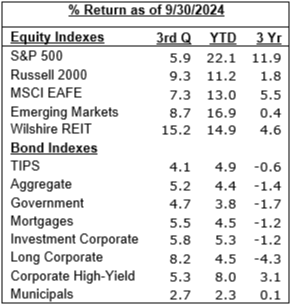
In July, a disappointing employment report was released. Weak numbers again elevated fears that the economy was headed toward recession. The market reaction was swift and predictable. The S&P 500 fell roughly 8% and the Nasdaq Composite dropped 13% as some equity investors bolted for the exits. As is often the case, the drama didn’t last. The S&P 500 index quickly recovered the losses and ended up 6% for the quarter. Year to date, it is up 22%. These recent movements show the peril of knee-jerk reactions and the power of patience. Our approach stresses that long-term assets should be managed with restraint and a long-term mindset.
Encouraging Developments
There were other positives. Stock market returns for the past several quarters have been highly concentrated in just a handful of stocks. This group of large technology companies associated with the artificial intelligence boom soared, while other sectors were left in the dust. Smaller companies and international stocks couldn’t keep up. The extremely narrow leadership was concerning. It was also frustrating to investors who favored a more diversified portfolio, rather than going all in on a few names in one sector. The big tech trend marched on.
That all changed in the third quarter. As economic reports continued to come in, and it appeared the Fed could pull off the elusive “soft landing,” market leadership began to broaden. While large growth stocks were up for the quarter, other sectors took the lead. Industrials, utilities, and other more value-oriented stocks outperformed the technology sector by a wide margin. Smaller U.S. stocks and international stocks, making up for lost time, also outperformed. We usually pay little attention to what outperforms what on a quarterly basis since we don’t build portfolios for the short-term. So, while there are certainly no guarantees, it is encouraging to see broader market leadership.
Of course, the big development, which came late in the quarter, was the Fed finally cutting interest rates. The Fed often makes quarter-point moves; instead, they boldly cut rates by half a point. This long-awaited change in direction brought greater attention to bonds.
The Bloomberg Aggregate Index, which is a measure of the broad bond market, rose 5.2% for the quarter and is up 4.4% for the year. While the Bloomberg Municipal Index, which is generally free of Federal income taxes, rose 2.7% for the quarter and is up 2.3% for the year.
Looking Ahead
So far, 2024 has been a rewarding year. However, this is no time to coast into 2025. While we manage for the long-term, we are aware of and monitoring the current issues that may affect you.
The escalating tensions in the Middle East have unfortunately been with us for a while. Foremost in our minds is the human suffering that has occurred. We are also well aware of the economic affect this could have on oil prices, credit spreads and other potential impacts. While no one can know the ultimate outcome, we can prepare. Our process is to construct diversified, risk-aware portfolios in advance.
Another matter on the investor’s mind is the U.S. presidential election. This has been an eventful and often contentious presidential election cycle. As we approach election day, it is natural that some might feel anxious. People feel strongly about our country and its future. And again, while there are no guarantees, historical data has shown very little difference in stock market returns under Republican or Democrat administrations. Our approach to investing is often a decades-long process. As we said in our letter four years ago and say again today — while presidents come and go, we believe in the power of patient, disciplined investing.
It is a pleasure to serve you and your family. We are here to help. If you have any questions or concerns, just let us know.
Sincerely,
Lawrence Smith
Sources: CNBC, S&P Global, Wall Street Journal, Dow Jones Market Data, The Economist, Federal Reserve Bank, Oaktree Capital Management, Barclays Indices, Bloomberg Indices, MSCI
The performance of an unmanaged index is not indicative of the performance of any particular investment. It is not possible to invest directly in any index. Past performance is no guarantee of future results. This material represents an assessment of the market environment at a specific point in time and is not intended to be a forecast of future events, or a guarantee of future results. Three-year performance data is annualized. Bonds have fixed principal value and yield if held to maturity and the issuer does not enter into default. Bonds have inflation, credit, and interest rate risk. Treasury Inflation Protected Securities (TIPS) have principal values that grow with inflation if held to maturity. High-yield bonds (lower rated or junk bonds) experience higher volatility and increased credit risk when compared to other fixed-income investments. REITs are subject to real estate risks associated with operating and leasing properties. Additional risks include changes in economic conditions, interest rates, property values, and supply and demand, as well as possible environmental liabilities, zoning issues and natural disasters. Stocks can have fluctuating principal and returns based on changing market conditions. The prices of small company stocks generally are more volatile than those of large company stocks. International investing involves special risks not found in domestic investing, including political and social differences and currency fluctuations due to economic decisions. Investing in emerging markets can be riskier than investing in well-established foreign markets. The MSCI EAFE Index is designed to represent the performance of large and mid-cap securities across 21 developed markets, including countries in Europe, Australasia and the Far East, excluding the U.S. and Canada. The Russell 2500 Index measures the performance of the 2,500 smallest companies (19% of total capitalization) in the Russell 3000 index. The S&P 500 index measures the performance of 500 stocks generally considered representative of the overall market. The Wilshire REIT Index is designed to offer a market-based index that is more reflective of real estate held by pension funds. CRN-7163781-100824